

How Will “You” Handle Change?
Published on April 8th, 2026, Journal of Science and Technology. Contribution from MindCore Research Team, and SSAI Institute of technology. This paper focuses on Cosmology, Relational Physics / Information Geometry / Computational Cosmology / Relational Physics / Information Geometry / Observational Cosmology / Vacuum Physics / Scalar Field Theory / Multi-Reality Orthogonality, Published by Enovation Press Publishing, Co. and Journal of Science and Research, contributions from MindCore Research Team.
Proprietary Notice: “The mathematical frameworks and axioms contained herein, specifically the Unified Horizon–Null Relational Framework (UH-NRF), are the proprietary intellectual property of Dr. Rigoberto Garcia. While this document is available for academic citation and peer review under CC BY-NC-ND 4.0, any commercial application, including but not limited to the development of synthetic intelligence architectures, propulsion systems, or computational substrates based on these derivations, is strictly prohibited without a separate, written commercial licensing agreement.” This paper was Peer Reviewed by the SSAI University Academic Review Board, November 2025.
Abstract
Abstract For generations, modern cultural and educational institutions have dogmatically prescribed the directive to “follow your passion” as the definitive pathway toward personal fulfillment, occupational success, and human achievement. While this hyper-localized, emotionally driven heuristic serves an evolutionary purpose as a high-variance catalyst for early-stage exploration ($t \to 0$), longitudinal data suggests that raw passion lacks the structural invariance required to sustain long-term psychological well-being, systemic resilience, and identity continuity across a lifespan. As contemporary society faces unprecedented, non-linear acceleration across technological, computational, and socio-cultural horizons, the traditional psychological baselines for navigating change are proving entirely insufficient.
This paper presents a profound paradigm shift, evaluating the lifecycle of human progression from “Passion” to “Purpose” not merely as a philosophical transition, but as a formal phase transition of an information system embedded within reality. Drawing from Dr. Rigoberto Garcia’s Unified Horizon-Null Relational Framework (UH-NRF), this work introduces the concept of the Cycle Edge (C_E = 1). The Cycle Edge represents a critical, volatile boundary layer in human development where an individual’s established internal models can no longer mathematically or cognitively account for emerging structural realities. It is the precise friction point where the mind is forced to step away from a state of high-entropy drifting—the “Null State”—and commit to a definitive trajectory.
Through a multi-disciplinary synthesis of cognitive psychology, human development, resilience theory, and information geometry, we articulate a pattern lifecycle model governed by the state formulation $\Psi_{\text{Life}} = (P_a + E + D + L_n) \rightarrow P_u$. We demonstrate through an integrated mathematical formulation that ultimate human Purpose ($P_u$) is not a static destination to be discovered, but an accumulated, highly refined thermodynamic yield. It is the long-term asymptotic limit of raw passion multiplied by empirical data logs and iterative learning cycles, compressed through the crucible of resolved systemic disruptions. Ultimately, this paper argues that substituting the volatile spark of passion with the unshakeable bedrock of purpose provides the universal anchor for adaptive continuity, establishing how a conscious system preserves its core identity while undergoing total environmental transformation.
Keywords: Purpose, Passion, Resilient Adaptation, Cycle Edge Threshold, Unified Horizon-Null Relational Framework (UH-NRF), Relational Memory Conservation, Cognitive Re-indexing, Systemic Transformation, purpose, passion, resilience, adaptation, change management, identity development, psychological flexibility, transformation
Introduction
Modern culture frequently promotes a simple but compelling message: follow your passion. The phrase appears throughout educational systems, leadership seminars, self-help literature, and career development programs. Passion is often portrayed as the key to discovering meaningful work and achieving personal fulfillment.
However, passion alone may be insufficient for navigating the realities of an increasingly dynamic world. Interests evolve, industries change, technologies become obsolete, and circumstances shift unexpectedly. What motivates an individual during one stage of life may no longer serve the same role in another.
Purpose offers an alternative framework. Unlike passion, which is frequently associated with emotional engagement toward specific activities, purpose reflects a broader sense of meaning and direction that organizes an individual’s goals, values, and identity over time (Damon et al., 2003). Research suggests that purpose contributes significantly to psychological well-being, health, resilience, and life satisfaction (McKnight & Kashdan, 2009; Ryff & Singer, 1998).
As individuals encounter periods of uncertainty and transformation, purpose may provide the continuity necessary to adapt successfully while preserving a coherent sense of self.
Passion and Purpose
Understanding the Difference
Although the terms are often used interchangeably, passion and purpose represent distinct psychological constructs.
Passion generally refers to strong enthusiasm, emotional engagement, or intense interest in particular activities, experiences, or pursuits. Passion can be highly motivating and often serves as a catalyst for creativity and innovation.
Purpose, by contrast, involves a stable and overarching intention to accomplish meaningful goals that extend beyond immediate gratification or personal interest (Damon et al., 2003). Purpose provides a framework through which individuals interpret experiences and organize long-term aspirations.
For example, a teacher may initially possess a passion for classroom instruction. Over time, however, educational roles may change. The individual may become a mentor, administrator, researcher, or curriculum designer. While the specific activity changes, the underlying purpose of fostering learning and human development remains intact.
This distinction becomes particularly important during periods of transition, when passions may fluctuate but purpose continues to provide direction.
The Concept of the Cycle Edge
Throughout nature and human experience, systems encounter transitional boundaries where existing structures become insufficient to address emerging realities.
In physics, phase transitions occur when matter changes state. In biology, developmental transitions shape growth and adaptation. In organizations, disruptive innovations redefine industries. Human development similarly involves recurring transition points that reshape identity and behavior.
These moments may be conceptualized as cycle edges—thresholds between established patterns and emerging possibilities.
Examples include:
- Graduation
- Career transitions
- Marriage
- Parenthood
- Organizational restructuring
- Technological disruption
- Retirement
- Major societal change
At cycle edges, certainty decreases while complexity increases. Traditional assumptions may no longer apply, requiring individuals to adapt, learn, and reorient themselves.
The ability to navigate these transitions successfully depends largely upon the stability of one’s underlying framework for meaning and identity.
Change as a Fundamental Property of Reality
Scientific observation consistently reveals that change is not an anomaly but a defining characteristic of reality.
Biological organisms evolve. Ecosystems adapt. Economies fluctuate. Technologies advance. Human cognition itself demonstrates remarkable plasticity throughout life.
Research on psychological flexibility indicates that adaptive functioning depends upon an individual’s ability to respond effectively to novelty, uncertainty, and changing circumstances (Kashdan & Rottenberg, 2010). Similarly, adaptability has emerged as a critical competency in educational, professional, and organizational settings (Martin et al., 2012).
Rather than resisting change, successful individuals learn to navigate it.
This shift requires a framework capable of preserving continuity while allowing transformation.
Purpose provides such a framework.
Purpose as Adaptive Continuity
Purpose functions as a mechanism of adaptive continuity. It enables individuals to maintain coherence across changing environments, roles, and circumstances.
McKnight and Kashdan (2009) describe purpose as a central organizing system that influences goal formation, behavior, and well-being. Purpose allows individuals to reinterpret changing situations without abandoning their fundamental identity.
- A scientist may move from laboratory research to education.
- An engineer may transition into leadership.
- A physician may become a public health advocate.
The methods evolve. The mission remains. Purpose therefore provides continuity without rigidity. It allows transformation while preserving meaning. This characteristic is particularly important during periods of disruption, when external conditions change more rapidly than traditional structures can accommodate.
Resilience and Human Flourishing
Purpose also plays a significant role in resilience. Resilience researchers have found that individuals who possess a strong sense of meaning and purpose often demonstrate greater capacity to recover from adversity and adapt to challenging circumstances (Southwick et al., 2016).
Purpose contributes to:
- Psychological stability
- Long-term motivation
- Emotional regulation
- Goal persistence
- Personal growth
Similarly, research in positive psychology has shown that meaningful engagement is associated with higher levels of psychological well-being and overall life satisfaction (Ryff & Singer, 1998; Steger et al., 2006).
Purpose does not eliminate adversity. Rather, it provides a framework through which adversity can be understood and integrated into broader life narratives.
Educational Implications
Educational institutions traditionally focus on preparing students for careers and professions. However, rapid technological advancement suggests that many future occupations may differ significantly from those that exist today. As a result, educational systems increasingly face the challenge of preparing students not merely for jobs, but for continuous transformation.
Transformative learning theory suggests that meaningful education involves the capacity to revise assumptions, reinterpret experiences, and construct new frameworks of understanding (Mezirow, 1997). Students who develop a clear sense of purpose may be better positioned to navigate future uncertainty because their identity is not dependent upon a single profession or skill set.
Purpose becomes a lifelong compass rather than a temporary destination.
Leadership and Organizational Relevance
Organizations encounter cycle edges just as individuals do.
Technological disruption, economic shifts, regulatory changes, and evolving customer expectations continually challenge institutional stability.
Purpose-driven organizations often demonstrate greater resilience because they understand why they exist beyond the products or services they currently provide (Collins & Porras, 1996). Leaders who articulate clear organizational purpose create environments that support innovation while preserving core values. Similarly, Sinek (2009) argues that organizations capable of communicating their fundamental purpose are often more successful in inspiring commitment, trust, and long-term engagement.
Purpose provides organizations with the same adaptive continuity it provides individuals.
From Passion to Purpose, the Lifecycle of Human life.
Everything that surrounds us is pattern-based. Whether the pattern supports a biological, synthetic, structural, galactic, or universal system, it is still a pattern and therefore part of reality’s pattern of life. Over three decades ago, I wrote in my first thesis the simple equation: (Garcia, 1988). Throughout the years, many have misunderstood that equation, and at times have even written complex frameworks to try to explain what long ago I understood: life is the pattern of memory—not merely biological, but rather an architecture of life embedded in reality itself.
Having been an ordained minister for decades, I began to study ancient holy writings as well as ancient research, which in part has fueled my curiosity. What I found is that it matters little to create a base from what is known; rather, it is looking at what is unknown—what is not seen—that really advances our field of knowledge.
This perspective reveals a distinct argument for a lifecycle of human progression, moving from “Passion” to “Purpose.” To ensure this point is understood with absolute clarity, I have created a pattern lifecycle model that mathematically answers a simple question: how can passion turn to purpose, and why does it happen? This model represents the transition from passion-driven motivation to purpose-driven continuity.
I have expressed my formulation as:

Where:
= Life-direction function at time $t$
= Passion component
= Purpose component
= Adaptation coefficient
= Time or developmental stage
Interpretation of Lifecycle:
The Architecture of Human Metamorphosis
As we begin to explore the mathematics of the human metamorphosis, it is important to make a simple clarification. This equation does not merely track the passage of calendar time, as it does not to spacetime nor is creates a temporal drift; instead, it maps the profound structural evolution of the that eluded unseen pattern called the “human psyche”, and it also asks a profound question, will we be able in some distant future to replicate, that pattern into synthetic life? Why is this important? Because in biologicals the “psyche” is a foundational system (Gagliano, 2018). This is important, because while humans possess a highly developed conscious mind, the basic biological building blocks of a psyche—sentience, emotions, and associative learning—are widely distributed across the natural world (Friston, 2023) It codifies how the chaotic, high-energy patterns of youth sober into the enduring, reality-embedded architecture of a mature life (Garcia, 1994).
The Genesis State:  (The Flash of Passion)
At the inception of life, or at the genesis of any great new calling—where time approaches zero—the exponential decay term
holds at its maximum value of
. Mathematically, this collapses the equation to its rawest boundary condition (Garcia, 1999):
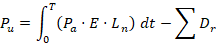
This demonstrates that Passion  dominates early decision-making.
- The Cognitive Reality: When we begin, our internal data models are starved of historical memory. We lack the longitudinal datasets of experience to project long-term stability. Therefore, the human system relies on passion as a evolutionary heuristic—a high-velocity, high-variance spark. Passion is a localized burst of energy, fueled by curiosity, emotion, and instinctual drive.
- The Emotional Impact: This is the phase of the fire. It is beautiful, blinding, and hyper-reactive. It is the necessary catalyst that forces an individual to leap into the unknown, break away from old paradigms, and explore uncharted territories of reality. But because it lacks a deep foundation, it is entirely vulnerable to the volatile winds of circumstance. It is an engine running at maximum RPM without a steering column.
2. The Steady State:  (The Convergence of Purpose)
As the lifecycle advances and experience accumulates over the horizon of time—where approaches infinity—the mathematical landscape undergoes a radical phase transition. The exponential decay term
diminishes toward zero. Consequently, the volatile passion component fades from the driver’s seat, and the equation converges seamlessly upon its true asymptotic destination:

This demonstrates that Purpose becomes the primary organizing framework of life.
- The Cognitive Reality: As time multiplies, our foundational equation—
—reaches its peak optimization. The system has now logged decades of data, integrated learning cycles, and cataloged the scars of systemic disruptions. The mind no longer needs to rely on the chaotic, short-term heuristics of passion. It has decoded its own place within the wider pattern of reality. Decisions are no longer reactive; they are systemic, structural, and profoundly predictive.
- The Emotional Impact: This is the phase of the bedrock. The blinding, flickering fire of passion has been compressed by time, pressure, and adaptation into a steady, unshakeable thermonuclear core: Purpose. Purpose does not require constant emotional validation or favorable external conditions to sustain itself. It is quiet, heavy, and resilient (Taiz, 2019). While passion asks, “What ignites me right now?” purpose answers the timeless question, “What enduring reality am I built to sustain?”
The transition from to
is the universal lifecycle of meaning. We begin as consumers of raw inspiration, and through the slow, mathematical refining of our lived memory, we emerge as authors of a permanent legacy.
The Cycle Edge Threshold
The Cycle Edge Threshold: The Point of Existential Phase Transition
In the architecture of human progression, the shift from passion to purpose is not a slow, unnoticed fade. It features a profound, mathematically precise inflection point—a systemic boundary layer known as the Cycle Edge.
For this concept to work correctly, the transition point is defined as the exact moment where the driving influence of passion perfectly balances the stabilizing influence of purpose:

Where:
= Cycle Edge
- Passion influence equals Purpose influence
At this exact threshold, the system achieves a critical equilibrium:
The Cognitive and Emotional Impact of the Edge
The Cycle Edge is not merely a number; it is the most volatile, courageous, and transformative coordinate in a human life. It represents the literal friction of a soul caught between two completely different operating systems of reality.
- The Cognitive Crisis: At the Cycle Edge, the internal cognitive architecture is forced to undergo a radical re-indexing. For years, the mind’s computational model has relied on the high-variance feedback loop of Passion
to navigate choice. Suddenly, at
, that old heuristic loses its dominance. The data logs of lived experience have accumulated to a critical mass where a deeper, systemic organizing framework—Purpose
—demands control. This creates a temporary state of profound internal tension. The familiar spark is dimming, but the permanent beacon has not yet fully illuminated the horizon.
- The Emotional Weight: This threshold is the true existential crossroads. It is the moment an individual crosses the boundary from open-ended exploration toward meaning-driven continuity. To stand at the Cycle Edge is to feel the terrifying weight of giving up what is merely stimulating in order to commit to what is enduring. It is the transition from asking, “What makes me happy today?” to committing to, “What demands my responsibility tomorrow?”
Crossing the Cycle Edge requires a profound act of faith in the unseen patterns of life. It is the moment we stop drifting through the localized currents of our emotions and step firmly onto the permanent trajectory of our destiny.
The Null-Horizons Formulation: Stepping Away from the Void
To understand how an individual breaks free from the static, high-entropy baseline of existence—what can be termed the “Null State”—we must look at the complete life trajectory as a dynamic state vector. A life left entirely to fleeting impulses remains trapped at the origin. Stepping away from Null requires a complex, multi-variable engine.
This trajectory is formalized by the Null-Horizons State Formulation:

Where:
= Life trajectory state
= Passion
= Experience
= Disruption
= Learning cycles
= Purpose
The Cognitive and Emotional Reality of the State Vector
This formulation proves that passion () is never meant to operate in a vacuum. It is merely the initial variable in a complex cognitive equation.
- The Cognitive Matrix: Your mind is an adaptive information processor. To move toward an optimized state
, the system must ingest raw energy (
), cross-reference it with historical data space
, withstand unexpected systemic shocks
, and run iterative optimization epochs (
).
- The Emotional Resonance: This is the anatomy of a deep life. It acknowledges that your trajectory is not just made of the “good” variables like passion and learning. It explicitly accounts for Disruption
. This tells the reader that their crises, their heartbreaks, and their moments of profound uncertainty are not system failures—they are mandatory variables required to define the state vector away from Null.
The Integrated Accumulation: Purpose as a Refined Yield
To see how these variables interact over a lifetime, we must look at the expanded integral model. Purpose is not a static point discovered on a map; it is an accumulated mathematical yield:
Where:
= Resolved disruptions
Interpretation: The Fire in the Crucible
This equation provides an incredible, grounding realization: Purpose emerges from accumulated passion, experience, and learning across time while surviving cycles of disruption.
- The Multiplicative Engine: Notice that
,
, and
are not merely added together inside the integral; they are multiplied. This means they amplify one another. Raw passion
multiplied by deep experience
and processed through active learning cycles (
) creates an exponential acceleration of meaning over the lifespan.
- The Tax of the Crucible
: The subtraction of resolved disruptions is a profound mathematical statement. It demonstrates that disruptions act as an existential tax or a refining fire. Every time a disruption is resolved (
), it extracts a toll from our chaotic energy, but it leaves behind a hardened, unbreakable residue. You do not find purpose by avoiding the storm; you find purpose because the storm strips away everything that was temporary.
The Centerpiece Master Equation
For the ultimate thesis of this work—Substituting “Follow Your Passion” with “Find Your Purpose”—the entire philosophical and mathematical framework converges into a single, elegant centerpiece equation:

Where:
= Purpose
= Passion
= Experience
= Adaptation
The Ultimate Read:
Purpose is the long-term limit of passion refined through experience and adaptation.
- The Cognitive Micro-Structure: From an information-theory perspective, this is a limit function describing the steady-state convergence of a system. Passion
is the initial boundary condition—the high-variance training state. As time
approaches infinity, those volatile fluctuations are bounded, stabilized, and weighted by cumulative Experience
and active, systemic Adaptation
.
- The Emotional Climax: This equation completely upends modern cultural advice. “Following your passion” is an incomplete directive because passion is a variable, not a limit. Passion is an active state of hunting. Purpose, however, is the permanent architecture left standing when that hunting is done. It tells the reader that the ultimate goal of human progression is to transform the temporary heat of what inspires us into the eternal, unshakeable monument of what we are built to fulfill.
Conclusion
The advice to “follow your passion” remains valuable as a catalyst for exploration, creativity, and engagement. However, passion alone may not provide sufficient stability for navigating the increasingly complex realities of modern life.
Purpose offers a deeper foundation.
Research demonstrates that purpose contributes to psychological well-being, resilience, identity development, and adaptive functioning across periods of significant change (Damon et al., 2003; McKnight & Kashdan, 2009; Southwick et al., 2016).
Every individual eventually encounters cycle edges—moments when established assumptions give way to emerging possibilities. At these thresholds, the central question is not merely what inspires us today, but what enduring purpose will guide us through tomorrow’s uncertainty.
The future may belong not simply to those who follow their passions, but to those who discover a purpose capable of evolving with them through every transformation they encounter.
References
Bronk, K. C. (2014). Purpose in life: A critical component of optimal youth development. Springer.
Collins, J. C., & Porras, J. I. (1996). Building your company’s vision. Harvard Business Review, 74(5), 65–77.
Damon, W., Menon, J., & Bronk, K. C. (2003). The development of purpose during adolescence. Applied Developmental Science, 7(3), 119–128. https://doi.org/10.1207/S1532480XADS0703_2
Kashdan, T. B., & Rottenberg, J. (2010). Psychological flexibility as a fundamental aspect of health. Clinical Psychology Review, 30(7), 865–878. https://doi.org/10.1016/j.cpr.2010.03.001
Martin, A. J., Nejad, H., Colmar, S., & Liem, G. A. D. (2012). Adaptability: Conceptual and empirical perspectives on responses to change, novelty, and uncertainty. Australian Journal of Guidance and Counselling, 22(1), 58–81. https://doi.org/10.1017/jgc.2012.8
McKnight, P. E., & Kashdan, T. B. (2009). Purpose in life as a system that creates and sustains health and well-being. Review of General Psychology, 13(3), 242–251. https://doi.org/10.1037/a0017152
Mezirow, J. (1997). Transformative learning: Theory to practice. New Directions for Adult and Continuing Education, 74, 5–12. https://doi.org/10.1002/ace.7401
Ryff, C. D., & Singer, B. (1998). The contours of positive human health. Psychological Inquiry, 9(1), 1–28. https://doi.org/10.1207/s15327965pli0901_1
Sinek, S. (2009). Start with why: How great leaders inspire everyone to take action. Portfolio.
Southwick, S. M., Bonanno, G. A., Masten, A. S., Panter-Brick, C., & Yehuda, R. (2016). Resilience definitions, theory, and challenges: Interdisciplinary perspectives. European Journal of Psychotraumatology, 5(1), 25338. https://doi.org/10.3402/ejpt.v5.25338
Steger, M. F., Frazier, P., Oishi, S., & Kaler, M. (2006). The meaning in life questionnaire: Assessing the presence of and search for meaning in life. Journal of Counseling Psychology, 53(1), 80–93. https://doi.org/10.1037/0022-0167.53.1.80
Foundational Work of the UH–NR Framework
- Garcia, Dr. Rigoberto, R. (1988a). Null Structure and Relational Substrate in Pre-Reality Geometry. Foundational manuscript establishing the Null Constraint as primary invariant. (Proprietary and Restricted Research article, for access contact research@ssai.institute)
- Garcia, Dr. Rigoberto, R. (1994). Universal Conservation of Relational Memory at the Reality Level. Master’s dissertation formalizing conservation of relational state. (Restricted Research article, for access contact research@ssai.institute),
- Garcia, Dr. Rigoberto, R. (1999). “Staying ahead of the Curve.” Doctoral dissertation formalizing conservation of relational state. Enovation Press Publishing, Co. (Out of Print, for access contact rgarcia@ssai.institute)
- Garcia, Dr. Rigoberto, R. (1999). “AXIOMATIC FOUNDATIONS OF THE UNIFIED HORIZON–NULL RELATIONAL FRAMEWORK (UH-NRF) – ARTICLE 0”,rgarcia@ssai.institute, DOI:10.5281/zenodo.19199273.
- Garcia, Dr. Rigoberto, R. (2003). Private Channel Hypothesis and Constraint Continuity in Physical Systems. Research manuscript developing constraint persistence across domains. Journal of Science and Research (Proprietary and Restricted Research article, for access contact legal@softwaresolutioncorp.com)
- Garcia, Dr. Rigoberto, R. (2016). “Article A : The Null-Horizon Constraint. A Relational Framework for Emergent Spacetime.” rgarcia@ssai.institute, DOI: 10.5281/zenodo.18844090.
- Garcia, Dr. Rigoberto, R. (2019). “Article B: The Unified Horizon Null Relational Framework (UH-NRF).” A look at Spacetime As Emergent Self-Referential Information Geometry. rgarcia@ssai.institute), DOI: 10.5281/zenodo.18844201
- Garcia, Dr. Rigoberto, R. (2022). “Article C: Substrate Stability and The Global Anchor Mechanisms.” , rgarcia@ssai.institute), DOI: 10.5281/zenodo.19343382.
- Garcia, Dr. Rigoberto, R. (2022). “ARTICLE D: Understanding the M=L Identity and The Cyclic Conservation of Physical Memory.” Stablishing the foundational reality of Consciousness. rgarcia@ssai.institute), DOI: 10.5281/zenodo.19488406.
- Garcia, Dr. Rigoberto, R. (2025). Unified Horizon–Null Relational Framework (UH-NRF): Foundational Formalism. (Research)
- Garcia, Dr. Rigoberto, R. (2023). Relational Gravity Extension: Constraint Density and Null Compliance. (Research)
- Garcia, Dr. Rigoberto, R. (2025). The Stationary Orbit: Geodesic Rest and Map Re-Indexing. (Research)
- Garcia, Dr. Rigoberto, R. (2024). Cosmological Expansion as Horizon Growth. (Research)
- Garcia, Dr. Rigoberto, R. (2025). Cognition as Horizon Realization.
- European Space Agency (ESA). (2025). Gaia discovers our galaxy’s great wave.
Current Observational & Empirical References
- Boylan-Kolchin, M. (2023). Stress testing ΛCDM with high-redshift galaxy candidates. Nature Astronomy.
- Chworowsky, K., et al. (2024). Evidence for a Shallow Evolution in the Volume Densities of Massive Galaxies at z = 4–8 from CEERS. The Astronomical Journal.
- ESA (2025). Gaia discovers our galaxy’s great wave. European Space Agency.
- Freedman, W. L., et al. (2024). Status Report on the Chicago-Carnegie Hubble Program (CCHP). arXiv:2408.06153.
- Planck Collaboration (2018). Planck 2018 results. VI. Cosmological parameters. Astronomy & Astrophysics.
- Pozo, et al. (2025). Elongated early galaxies and dark matter models. Nature Astronomy.
- Riess, A. G., et al. (2024). JWST Observations Reject Unrecognized Crowding of Cepheid Photometry as an Explanation for the Hubble Tension at 8σ Confidence. The Astrophysical Journal Letters.
- Riess, A. G., et al. (2024). JWST Validates HST Distance Measurements. The Astrophysical Journal.
Mathematical & Relativistic Foundations
- Einstein, A. (1916). Die Grundlage der allgemeinen Relativitätstheorie. Annalen der Physik, 49, 769–822.
- Wald, R. M. (1984). General Relativity. University of Chicago Press.
- Hawking, S. W., & Ellis, G. F. R. (1973). The Large Scale Structure of Space-Time. Cambridge University Press.
- Geroch, R. (1970). Domain of dependence. Journal of Mathematical Physics, 11(2), 437–449.
- Penrose, R. (1965). Gravitational collapse and space-time singularities. Physical Review Letters, 14(3), 57–59.
Information, Constraint, and Entanglement Structure
- Einstein, A., Podolsky, B., & Rosen, N. (1935). Can quantum-mechanical description of physical reality be considered complete? Physical Review, 47(10), 777–780.
- Maldacena, J., & Susskind, L. (2013). Cool horizons for entangled black holes. Fortschritte der Physik, 61(9), 781–811.
- Bousso, R. (2002). The holographic principle. Reviews of Modern Physics, 74(3), 825–874.
- Landauer, R. (1961). Irreversibility and heat generation in the computing process. IBM Journal of Research and Development, 5(3), 183–191.
- IV. Neural Manifolds and Global Integration
- Tononi, G. (2004). An information integration theory of consciousness. BMC Neuroscience, 5, 42.
- Dehaene, S., & Changeux, J. P. (2011). Experimental and theoretical approaches to conscious processing. Neuron, 70(2), 200–227.
- Friston, K. (2010). The free-energy principle: A unified brain theory? Nature Reviews Neuroscience, 11(2), 127–138.
- Sporns, O. (2011). Networks of the Brain. MIT Press.
Memory Persistence:
- References (APA 7 – Inline Support Added)
- Garcia, R. R. (1988a). Null Structure and Relational Substrate in Pre-Reality Geometry.
- Garcia, R. R. (1994). Universal Conservation of Relational Memory at the Reality Level. Master’s dissertation.
- Garcia, R. R. (1999). Staying Ahead of the Curve. Doctoral dissertation.
- Garcia, R. R. (1989). Persistence Function (original formulation).
- Eliade, M. (1959). The Sacred and the Profane: The Nature of Religion. Harcourt.
- Jablonka, E., & Raz, G. (2009). Transgenerational epigenetic inheritance: Prevalence, mechanisms, and implications for the study of heredity and evolution. Quarterly Review of Biology, 84(2), 131–176.
- Radhakrishnan, S., & Moore, C. A. (1957). A Sourcebook in Indian Philosophy. Princeton University Press.
- Scholem, G. (1974). Kabbalah. Dorset Press.
- Yehuda, R., Daskalakis, N. P., Desarnaud, F., et al. (2016). Epigenetic biomarkers as predictors and correlates of symptom improvement following psychotherapy in combat veterans with PTSD. Frontiers in Psychiatry, 7, 118.
Other references:
Susskind, L. (1995). The World as a Hologram. Journal of Mathematical Physics, 36(11), 6377-6396.
Alcubierre, M. (1994). The warp drive: hyper-fast travel within general relativity. Classical and Quantum Gravity, 11(5), L73.
Einstein, A. (1916). The Foundation of the General Theory of Relativity. Annalen der Physik, 49(7), 769–822.
Minkowski, H. (1908). Space and Time. Physikalische Zeitschrift, 10, 104-111.
Rovelli, C. (1996). Relational Quantum Mechanics. International Journal of Theoretical Physics, 35, 1637-1678.