
Abstract
Geographic isolation has long been a barrier to healthcare and economic equity for remote mountain communities. Traditional logistics—reliant on winding roads, mules, or expensive helicopter charters—are often slow and weather-dependent. This article examines the expansion of drone delivery systems into high-altitude regions, focusing on the transition from experimental pilots to essential infrastructure. By integrating Beyond Visual Line of Sight (BVLOS) technology and AI-driven autonomous navigation, drone networks are significantly reducing delivery times for life-saving medical supplies and connecting local artisans to global markets. The findings highlight how these “aerial corridors” are fostering community trust in public health and creating resilient supply chains in the world’s most challenging terrains.
Introduction
In the most rugged terrains of the world, from the Appalachian peaks to the Himalayas, the “last mile” of delivery has historically been the most difficult to bridge. Mountainous regions suffer from poor connectivity, where traditional transport is often inefficient or impossible during extreme weather (Alzubaidy & Abdulmunem Al-Tameemi, 2024). However, 2025 and 2026 have marked a turning point as unmanned aerial vehicles (UAVs) transition from urban novelties to rural lifelines.
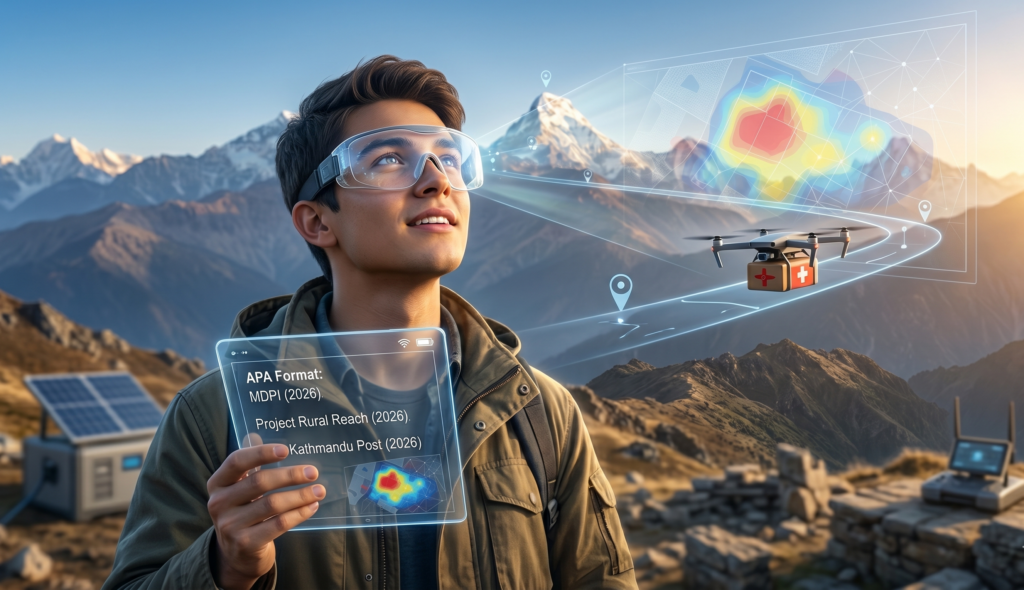
Drone logistics provide a rapid, flexible, and eco-friendly alternative to ground transport. In mountain regions, drones can bypass natural obstacles like landslides and steep inclines, reducing a six-hour trek by a porter to a mere 10-minute flight (Kathmandu Post, 2026). This expansion is not just a technological milestone; it is a movement toward “saving lives in rural communities” (Project Rural Reach, 2026).
Healthcare and Life-Saving Logistics
The most critical application of mountain drone technology is in the medical sector. In regions like Appalachia, pilot studies have demonstrated that drones can successfully deliver personal protective equipment (PPE) and medications to high-risk, isolated populations (University of Kentucky, 2025).
- Speed and Efficiency: On Virginia’s Eastern Shore, drone-based delivery reduced pharmaceutical trip times from 50 minutes to under 10 minutes for 80% of the population (PMC, 2024).
- Cold Chain Stability: In Madagascar, medical drone delivery (MDD) has stabilized the transport of vaccines, ensuring that temperature-sensitive products reach remote clinics without spoiling (MDPI, 2026).
- Emergency Response: Drones are increasingly used to deliver catheters, blood units, and anti-venom to rural hospitals where every second counts (Project Rural Reach, 2026).
Beyond the logistics, the presence of drones has a psychological impact. In remote villages, the sight of a drone often serves as a signal that medical supplies are available, which builds trust in the healthcare system and encourages villagers to seek professional care rather than relying solely on traditional medicine (MDPI, 2026).
Technological Innovations for High Altitudes
Operating drones in mountain environments requires more than standard consumer hardware. High altitudes present challenges such as thin air, which reduces lift, and extreme cold, which drains battery life.
Recent breakthroughs include the deployment of heavy-lift drones on Mount Everest, capable of carrying oxygen cylinders and expedition gear to camps at 5,000 meters (Kathmandu Post, 2026). To navigate these areas safely, researchers have introduced “optimization-based path loss models” that incorporate terrain constraints and AI-driven autonomous navigation (EurekAlert!, 2026). These advancements allow drones to compute efficient flight routes and avoid obstacles even when GPS signals are weak.
Economic Impact and Market Growth
The global drone delivery market is projected to reach $101.1 billion by 2030, with rural and remote areas representing the most profitable applications (Intotheminds, 2026).
- Local Economies: Drones allow small businesses and local artisans in mountain villages to connect with international markets, bypassing the high costs of traditional freight (IJRTI, 2025).
- Sustainability: A single drone can save up to 45 tons of CO2 emissions annually compared to combustion engine vehicles, making it a vital tool for environmental management in sensitive mountain ecosystems (PwC CEE, 2024).
Conclusion
Drone deliveries are no longer a future concept; they are a transformative reality for remote mountain villages. By overcoming geographic and transportation barriers, these systems are improving health outcomes, stabilizing supply chains, and fostering economic growth (MDPI, 2026). While regulatory hurdles and weather constraints remain, the continuous advancement in UAV design and AI navigation ensures that the most isolated communities on Earth are no longer left behind.
References
Alzubaidy, D. M., & Abdulmunem Al-Tameemi, O. (2024). Evaluating the perception of virtual reality in historical sites. BIO Web of Conferences, 97, 00082. https://doi.org/10.1051/bioconf/20249700082
EurekAlert!. (2026, January 28). Drone technology set to reshape disaster response, healthcare, environmental management, farming, and cybersecurity. https://www.eurekalert.org/news-releases/1114530
Intotheminds. (2026, February 25). Drone Delivery: Market Status and Future Prospects. https://www.intotheminds.com/blog/en/drone-delivery/
Kathmandu Post. (2026, May 2). China leads, US follows—Everest emerges as frontier for high-altitude drone tech. https://kathmandupost.com/money/2026/05/02/china-leads-us-follows-everest-emerges-as-frontier-for-high-altitude-drone-tech
MDPI. (2026, March 24). “For Us, Drones Mean Health”: How Medical Drone Delivery Affects Healthcare Outcomes, Accessibility, and Trust in Remote Regions of Madagascar. https://www.mdpi.com/2504-446X/10/4/228
PMC. (2024). Drone-based medication delivery for rural, flood-prone coastal communities. https://pmc.ncbi.nlm.nih.gov/articles/PMC12500137/
Project Rural Reach. (2026, March 26). Drones Deliver Critical Supplies When Every Second Counts. https://www.youtube.com/watch?v=1UPIzV3wetg
PwC CEE. (2024). Drone Deliveries: Taking Retail and Logistics to New Heights. https://cee.pwc.com/drone-powered-solutions/drone-deliveries-taking-retail-and-logistics-to-new-heights.html
University of Kentucky College of Medicine. (2025, February 27). Study shows potential for drone-based health resources delivery in Appalachia. https://medicine.uky.edu/news/study-shows-potential-drone-based-health-resources-2025-02-27t08-36-14