
Benefits of Using Our Null-Horizon 3D Model in the Classroom
Dr. Rigoberto Garcia
SSAI University Journal of Science and Research
MindCore Research Team
Abstract
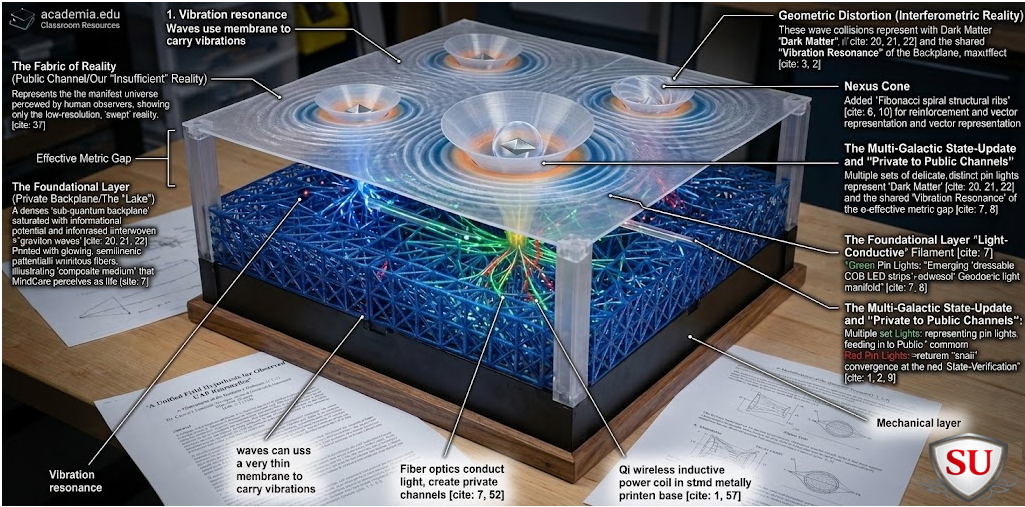
The Null-Horizon 3D Model was developed as a physical educational representation of concepts presented throughout the Null Horizons research series. While many theoretical frameworks in cosmology, systems science, cognition, topology, and field interactions are traditionally communicated through equations and diagrams, students often struggle to translate abstract mathematical relationships into intuitive understanding. The Null-Horizon 3D Model bridges this gap by transforming theoretical constructs into a tangible, interactive learning experience.
This model allows learners to visualize resonance, field interactions, geometric distortion, information propagation, state transitions, and multidimensional connectivity through a physical object that can be observed, explored, and discussed collaboratively. As both a research artifact and an educational tool, the model supports STEM education from middle school through graduate-level instruction.
Introduction
One of the greatest challenges in science education is helping students understand concepts they cannot directly see. Fields, waves, gravity, information networks, topology, resonance, and spacetime geometry often exist only as equations on a board or diagrams in a textbook.
The Null-Horizon 3D Model addresses this challenge by providing a physical representation of relationships described throughout the Null Horizons research series.
Rather than teaching students that:ds2=0
or discussing resonance interactions solely through mathematical notation, educators can physically demonstrate how structures connect, interact, propagate information, and influence neighboring systems.
The result is a classroom environment where abstract theory becomes visible.
1. Transforming Abstract Concepts into Visual Learning
Educational research consistently demonstrates that students learn more effectively when they can connect visual, tactile, and conceptual experiences.
The Null-Horizon Model provides representations of:
- Resonance systems
- Information pathways
- Field interactions
- State transitions
- Connectivity networks
- Emergent structures
- Geometric distortion
- Multi-channel communication architectures
Students can observe how local changes propagate through an interconnected structure, reinforcing systems-thinking principles.
Instead of memorizing terminology, students witness relationships directly.
2. Supporting Multiple Learning Styles
Traditional instruction often favors verbal and mathematical learners.
The Null-Horizon Model expands accessibility by supporting:
Visual Learners
Students observe:
- Structural relationships
- Resonance patterns
- Network architectures
- Spatial connectivity
Kinesthetic Learners
Students physically interact with the model, improving retention through touch and movement.
Analytical Learners
Students connect observed structures with:
- Equations
- Graphs
- Simulations
- Research papers
Collaborative Learners
The model naturally encourages discussion and hypothesis formation among groups.
3. Teaching Systems Thinking
Many modern scientific challenges require systems-level reasoning rather than isolated facts.
The model helps students understand:
- Interdependence
- Feedback loops
- Network effects
- Emergent behavior
- Complex adaptive systems
These concepts apply to:
- Physics
- Biology
- Neuroscience
- Artificial Intelligence
- Social Systems
- Environmental Science
Students begin recognizing that individual components rarely operate in isolation.
4. Introducing Advanced Scientific Concepts Earlier
The Null-Horizon Model enables educators to introduce advanced topics to younger learners using age-appropriate language.
Examples include:
Elementary School
- Waves
- Patterns
- Connections
- Cause and effect
Middle School
- Energy transfer
- Resonance
- Communication networks
- Scientific modeling
High School
- Field theory
- Information systems
- Geometry of space
- Complex systems
University Level
- Topology
- Dynamical systems
- Network theory
- Emergence
- Theoretical physics
- Cognitive architectures
The same model evolves with the student’s educational journey.
5. Encouraging Scientific Inquiry
A powerful educational tool should generate questions.
The Null-Horizon Model naturally encourages students to ask:
- What happens if one node changes?
- How does information travel?
- Why do patterns emerge?
- Can structures self-organize?
- How do local interactions affect the entire system?
These questions mirror the foundations of scientific research.
Students transition from consumers of information to investigators.
6. Bridging Mathematics and Reality
Many students struggle because equations appear disconnected from the real world.
The model serves as a bridge between:
Mathematical Language
σA+σB+σC
Physical Interpretation
Interactions among multiple states producing a measurable system outcome.
Similarly:I(A,B,C)
can be demonstrated as the influence generated when several interacting components affect one another.
Students begin understanding that equations are descriptions of relationships rather than arbitrary symbols.
7. Enhancing STEM and STEAM Education
The model naturally integrates:
Science
Observation and experimentation.
Technology
3D printing and digital design.
Engineering
Structural analysis and design principles.
Mathematics
Geometric and relational modeling.
Arts
Visualization, creativity, and conceptual communication.
This interdisciplinary approach aligns with modern educational objectives emphasizing innovation and problem-solving.
8. Preparing Future Researchers
Research begins with curiosity.
The Null-Horizon Model provides an entry point for students interested in:
- Physics
- Neuroscience
- Artificial Intelligence
- Systems Engineering
- Computational Modeling
- Advanced Mathematics
By interacting with a research-derived artifact, students gain exposure to the scientific process itself.
They learn that theories are not simply read; they are built, tested, visualized, challenged, and refined.
9. Supporting Research Communication
Researchers often face the challenge of explaining highly technical concepts to broader audiences.
The Null-Horizon Model functions as a communication bridge between:
- Researchers
- Educators
- Students
- Parents
- Policymakers
- Community stakeholders
Complex concepts become easier to explain when represented physically.
The model therefore serves both educational and outreach purposes.
Educational Benefits Summary
The Null-Horizon 3D Model:
✔ Makes abstract theories visible
✔ Supports visual and tactile learning
✔ Encourages scientific inquiry
✔ Promotes systems thinking
✔ Bridges mathematics and physical intuition
✔ Supports STEM and STEAM education
✔ Scales from elementary through university instruction
✔ Enhances collaborative learning
✔ Improves science communication
✔ Inspires future researchers
Conclusion
The Null-Horizon 3D Model represents more than a classroom demonstration. It is a research-informed educational platform designed to transform how learners interact with complex scientific ideas. By converting abstract theoretical relationships into a tangible, observable structure, the model enables students to explore concepts that traditionally remain hidden behind equations and diagrams.
As education increasingly emphasizes interdisciplinary thinking, innovation, and scientific literacy, physical models such as the Null-Horizon system provide powerful tools for fostering deeper understanding. Whether used to introduce young students to patterns and connectivity or to support advanced discussions of topology, resonance, and information dynamics, the model helps learners see science not merely as knowledge to memorize, but as relationships to discover.
In this way, the Null-Horizon 3D Model serves as both an educational instrument and an invitation to explore the frontier between observation, imagination, and scientific inquiry.